
Owning a Myrtle Beach vacation rental means paying the house's bills, replacing worn-out equipment, making loan payments, and keeping cash for closures and your own stays. Start with rental income, add guest charges, and subtract the costs of running the house and saving for replacements. Then show loan payments and income taxes separately to see how much cash you could keep.
Group House Costs Into Four Categories
Divide costs into everyday operations, major replacements and upgrades, loan payments, and purchase costs. Everyday operations include management, insurance, property taxes, utilities, cleaning, and routine services. List substantial replacements or upgrades separately, and use your loan terms to record principal and interest payments.
List closing costs and initial furnishings with the purchase budget. Set aside opening cash for bills due before rental payments arrive, insurance deductibles, and urgent repairs. A house needs cash when bills come due, even if its annual rental income covers its annual expenses.
For a large beach house in South Carolina, list the heating and cooling equipment, roof, decks, kitchen appliances, laundry equipment, pool, hot tub, elevator, and outdoor furniture. Budget for routine service where needed and plan for eventual replacement. Include each amenity's costs alongside any rental income you assume it will help bring in.
Use Your House's Insurance and Tax Costs
Base insurance costs on the house's rental use, construction, coverage limits, deductibles, and quoted policy terms. Record premiums separately from the cash you may need to pay a deductible. Include the building, contents, liability, wind-related losses, flood, and any intended protection for lost rental income in the coverage discussion.
FEMA's flood insurance coverage explanation states that most homeowners insurance excludes flood damage. NFIP building and contents coverage are typically purchased separately, each with its own deductible, and NFIP coverage excludes financial losses from business interruption. Count an insurance payment toward a closure's costs only when the applicable policy covers that loss.
Local governments administer and collect South Carolina property tax with help from the Department of Revenue. Use the house's parcel, tax classification, and current local calculation in your budget. If buying the house or renting it could change its tax treatment, label that amount as unresolved until the local office provides the calculation for your property.
The South Carolina property tax overview also identifies business personal property tax on furniture, fixtures, and equipment owned and used in a business. List any applicable tax on those items separately from the tax on the real estate so your budget includes both bills.
Match Guest Charges to Their Costs
Match cleaning fees collected from guests to cleaner bills, linen costs, and turnover supplies. For example, collecting a cleaning fee adds money to your receipts, and paying the cleaner takes money back out. Record both before calculating what you keep.
Do the same for pet fees, pool heating, damage waivers, and other separate guest charges that apply. Your booking and service agreements should show who receives each charge and who pays its related cost. Track taxes collected for payment to the authorities separately from the house's rental revenue.
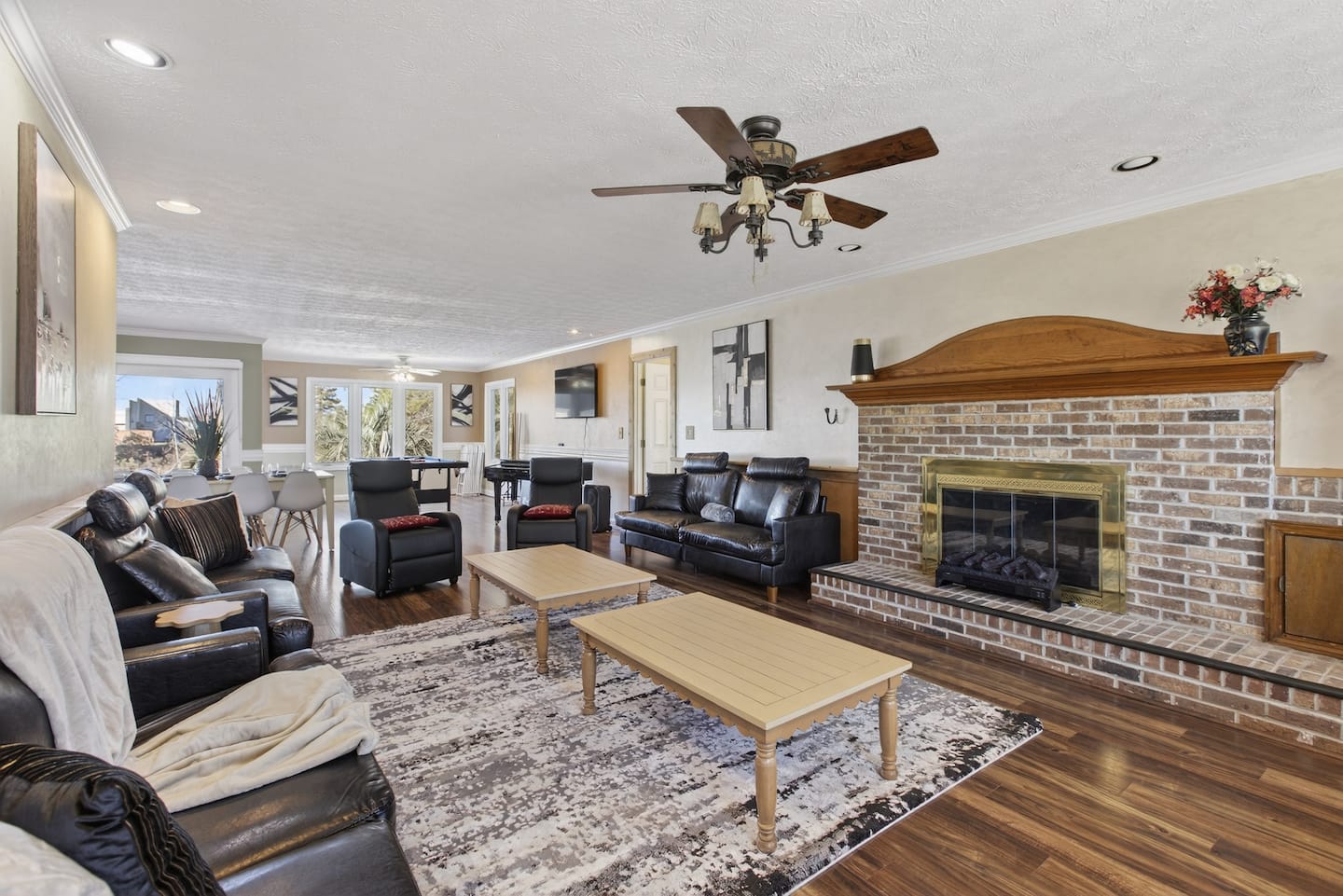
The furnished living room in the Myrtle Beach Intracoastal home shows sofas, ceiling fans, and a fireplace. Include furniture, appliances, and fixed equipment in the replacement inventory, with separate allowances for maintenance and eventual replacement. This waterfront house is on the Intracoastal Waterway. Its photograph illustrates a furnishing inventory; it establishes no annual costs or rental earnings.
Give booking-platform fees, payment processing, discounts, and refunds their own entries. When a platform sends money after subtracting fees, use the reservation statement to show the full booking amount and each deduction. This lets you account for each expense once.
Example: An Annual House Budget
These invented amounts demonstrate the arithmetic. They are neither a house forecast nor insurance or tax quotes. Start with $180,000 in nightly revenue and $18,000 in guest cleaning charges. A 10% management fee on nightly revenue is $18,000. Assume all other operating bills together total $86,000, including $18,000 in cleaning costs.
| Budget step | Amount |
|---|---|
| Nightly revenue plus cleaning receipts | $198,000 |
| Management at assumed 10% | $18,000 |
| All other operating bills, assumed aggregate | $86,000 |
| Total operating bills | $104,000 |
| Cash after operating bills | $94,000 |
| Replacement savings, assumed | $12,000 |
| Cash after replacement savings | $82,000 |
The cleaning fees collected exactly cover the cleaning expense in this example. Setting money aside for replacements reduces what you can take out of the property; show that saving separately from bills for current work. Major purchases, loan payments, and income taxes still need their own calculations after this table. A forecast of oceanfront rental income needs those same deductions before it represents money available to the owner.
Calculate Your Annual Ownership Budget
Change the annual amounts below to match your own assumptions. Nightly revenue excludes cleaning receipts and taxes collected for remittance. Enter cleaning receipts and cleaning bills separately; exclude cleaning from other operating costs to count each bill once. Management applies only to nightly revenue. This cash budget estimates cash remaining before income taxes. Tax deductions and property valuation require separate calculations. Revenue is not guaranteed.
Calculate the Management Fee on Your Bookings
Checkmate management in Myrtle Beach starts from 10% of the nightly rate, with a 10%–15% range confirmed after reviewing the home and its location. Near-beach homes and other strong locations can qualify for the lower end. Cleaning and additional fees are excluded from the commission calculation. Spell out specialty service costs and other owner charges separately in the agreement.
Subtract Loan Payments and Save for Replacements
Subtract scheduled principal and interest payments after calculating cash from operations. For example, hypothetical yearly loan payments of $60,000 reduce the example’s $82,000 after replacement savings to $22,000 before income taxes. That calculation includes principal paid back to the lender; principal needs its own tax treatment.
Plan replacements using the equipment's condition, likely work, and current estimates for your house. Record money put into replacement savings and money spent from it separately so you count each cost once. A storm deductible or major breakdown can require extra cash even in a year when rental receipts exceed operating bills.
Owners can discuss management from 10% using the house budget and a list of the services they need. At the example’s assumed 10%, the fee on $180,000 in nightly revenue is $18,000. The table leaves $82,000 after replacement savings and before loan payments and income taxes; the written quote determines the actual fee.
Track Owner Stays and Shared Expenses
Your stays take nights off the rental calendar while bills such as insurance, taxes, internet, and routine service continue. Record fair-rental days, personal-use days, and maintenance visits separately. Those records help you split shared expenses for tax purposes.
Under the general method in IRS Publication 527, divide days actually rented at a fair rental price by the combined rental and personal-use days to find the rental share of shared operating expenses. Leave vacant days out, including days offered for rent. For a hypothetical 80 rented days and 20 personal-use days, the rental share is 80%, assigning $8,000 of a $10,000 shared operating expense to rental use before deduction limits.
Days spent working substantially full time on repairs and maintenance generally count as maintenance days. Record that work separately from recreation and ordinary owner stays. The IRS treats the dwelling as a home when personal use exceeds the greater of 14 days or 10% of fair-rental days; that treatment can limit rental deductions.
Money saved for future work, loan principal, improvements, and current operating bills each need their own accounting and tax treatment. Use the day-based rental share where it applies, then apply the deduction rules for each kind of expense.
Ten Checks for Your Ownership Budget
- Rental receipts: Separate nightly revenue, guest charges, and taxes held for remittance.
- Management: Multiply the contracted percentage by the agreed revenue base. At 10%, $1,000 in nightly rent produces a $100 fee.
- Booking costs: Reconcile platform and processing deductions against each reservation.
- Turnovers: Match cleaning collections to cleaning, linen, and supply invoices.
- Insurance: Use rental-use quotes and record premiums, exclusions, and deductible cash separately.
- Property taxes: Include parcel-specific real estate taxes and any applicable business personal property bill.
- Utilities and amenities: Include internet, electricity, water, pool service, and other equipment actually at the house.
- Repairs and replacements: Separate current maintenance invoices from savings for future equipment and furniture.
- Financing and purchase cash: Include principal, interest, closing costs, initial furnishings, and opening cash in their respective budgets.
- Owner stays and closures: Remove unavailable nights from the rental forecast and retain cash for bills that continue during a closure.
Bottom Line: Budget for the Cash You Actually Keep
A house can cover its operating bills and still need owner cash after loan payments and replacement savings. In the hypothetical budget, $198,000 of receipts leaves $22,000 before income taxes after those outflows. Match cleaning receipts to cleaning bills, apply management only to its agreed revenue base, and replace the example amounts with property-specific quotes and records. Keep cash available for timing gaps, deductibles, and unexpected work before deciding how much of an annual surplus you can withdraw.
To compare Myrtle Beach rental managers fairly, calculate what each would charge on the same bookings and look at the services included in that fee. A workable ownership decision needs a budget that still makes sense when revenue falls or a major bill arrives. Run those less favorable assumptions before committing your cash.