
To estimate rental income for a Myrtle Beach oceanfront house, work out how many nights it can rent, what guests would pay, and which bills come out of that money. Use bookings from similar whole houses and put your own stays on the calendar. Keep cleaning charges, expenses, loan payments, and income taxes separate so you can see what you would keep.
Compare Houses With Similar Guest Space
Compare detached houses with similar permitted guest limits, bedrooms, bathrooms, beach frontage, and amenities. A resort condo gives guests shared facilities and different access to the beach and building. For a large house rented to one group, bookings from similar whole houses give you a closer comparison than condo revenue per bedroom.
Write down each comparison house's address and the city or county responsible for its rental rules. Myrtle Beach, North Myrtle Beach, Surfside Beach, and Garden City are different locations, and the authorities responsible for rental rules can differ. Find the specific location of a listing labeled Grand Strand before using its bookings to estimate income for a purchase.
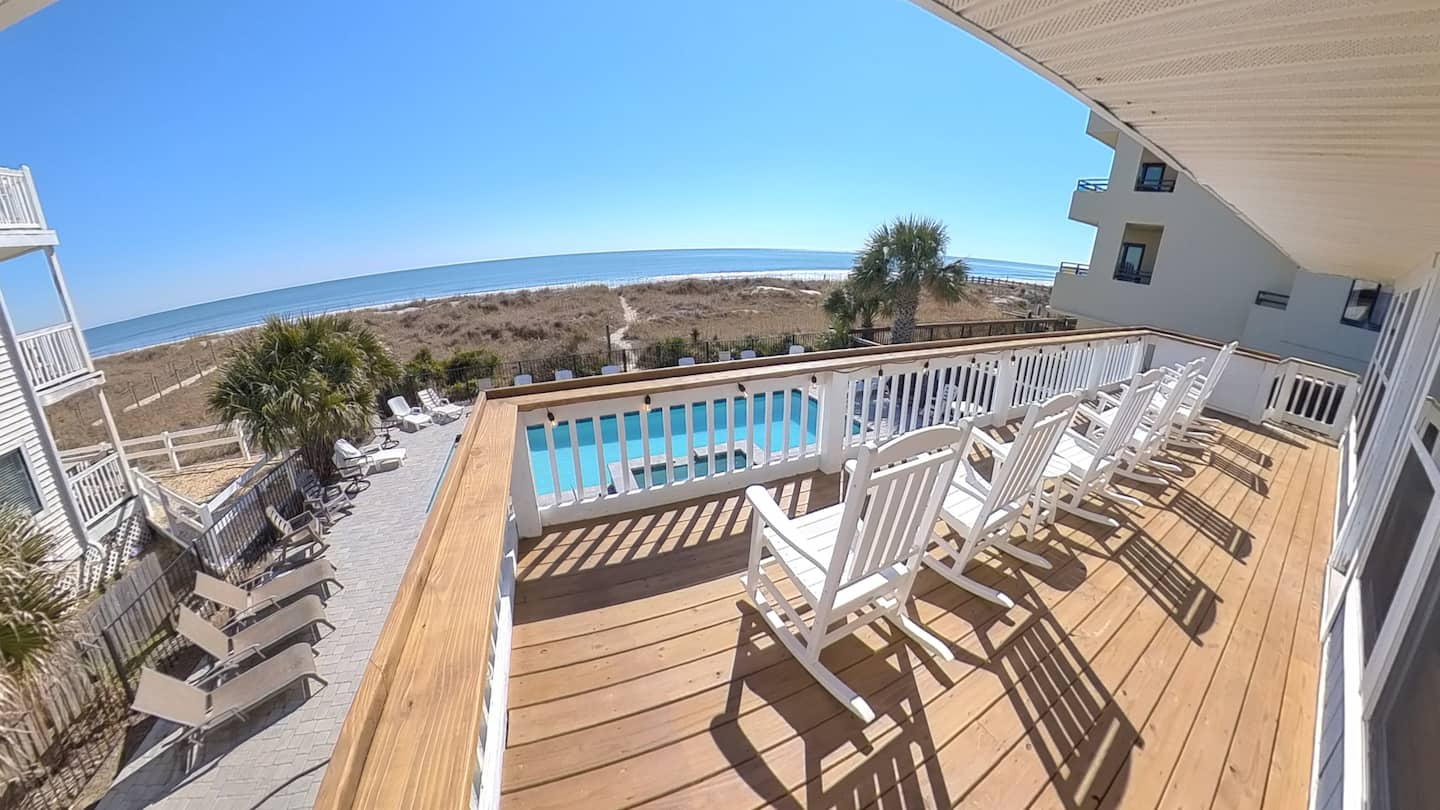
Describe how guests reach the sand, which rooms have ocean views, and where the group can gather outside. Include parking, bathrooms near each sleeping area, dining seats, elevators, and pool availability. A house that sleeps a large group also needs enough space and amenities for that group to use comfortably.
The host's Golden Mile oceanfront listing advertises six bedrooms, five bathrooms, a private pool, hot tub, and game room. Record the bedroom-to-bathroom ratio, gathering spaces, and available amenities when choosing comparison bookings.
An eight-bedroom North Myrtle Beach house can offer a different arrangement: the host of the split-floor oceanfront home describes two four-bedroom, two-bath units, each with its own kitchen and living area, reached through separate exterior entrances with no interior connection. Groups sharing meals and guests who prefer separate spaces may need different arrangements. Match this layout as well as bedroom count when choosing comparison houses.
These are advertised property features. A useful income comparison still needs actual paid bookings, matching dates, and the documented guest limit for each house. Listing photos and bed counts establish no annual earnings or occupancy rate.
A third comparison, the host’s eight-bedroom oceanfront house, advertises room for 28 guests, eight bathrooms, and 14 beds. Airbnb’s platform summary displays “16+ guests.” Treat the host’s larger advertised capacity as a description of the offering, with the documented permitted guest limit controlling your estimate. Its room inventory and ocean-facing outdoor areas help describe a comparable property; actual paid reservation records supply the income evidence.
Use Rates Guests Actually Paid
For a house already renting, use booking records that show stay dates, accommodation charges paid, discounts, refunds, cancellations, and dates reserved for the owner. Divide the rental revenue actually collected by the paid nights to find the average nightly rate. Put cleaning charges and taxes in separate columns to keep the calculation tied to the price of the stay.
A listing's advertised price tells you what the owner is asking for those dates. An unavailable date could be a booking, an owner stay, repairs, or a booking restriction. Count it as paid only when a booking record shows the stay and the money collected.
For a newly bought or renovated house, use comparison bookings that match its layout, condition, location, and available dates as closely as possible. You can try a higher-rate estimate for a new kitchen or amenity and label it as an assumption. Support any specific increase with bookings from houses that offer something similar. Different Myrtle Beach management companies may provide different booking records and reporting, so use the same revenue definition across their estimates.
Count the Nights You Can Rent
Start with 365 nights and subtract owner stays, planned work, and other known closures. Split the remaining nights into seasons. Minimum stays, required arrival days, and gaps between reservations can leave some available nights unbooked.
A hypothetical house with 28 owner nights and 12 maintenance nights has 325 nights available to rent. If guests pay for 195 nights, occupancy is 60% of available nights and about 53.4% of all 365 nights. Label each percentage so you know which calendar it measures.
Put owner stays on their actual dates before estimating income. Taking seven nights out of a high-rate season can reduce income more than taking seven nights out of a lower-rate season. Count replacement bookings only where the remaining calendar has room for them.
Calculate Rental Revenue by Season
All rates and booking counts in this example are invented to show the math. Use them only to follow the calculation; estimating your house's income requires actual bookings from comparable houses. Paid nights must fit within the available calendar; multiply them by the average nightly rate guests pay to calculate rental revenue.
| Period | Bookable nights | Paid nights | Average rate paid | Revenue |
|---|---|---|---|---|
| Higher-rate period | 100 | 85 | $1,200 | $102,000 |
| Middle-rate period | 130 | 80 | $700 | $56,000 |
| Lower-rate period | 95 | 30 | $400 | $12,000 |
| Annual total | 325 | 195 | $871.79 rounded annual average | $170,000 |
Divide $170,000 by 195 paid nights to get the annual average of $871.79. That gives every paid night the same weight. Keep the separate seasonal rows when you add your house's records, since each season has a different number of bookings.
Match Income to Permitted Guest Limits
Use the house's documented permitted guest limit in your estimate, listing, and rental agreement. Match that limit to the sleeping layout and the number of guests the house can comfortably serve. Adding beds still leaves you bound by the permitted guest limit. Across South Carolina, address-specific local requirements belong in the purchase and operating assumptions.
Record pool-heating dates, elevator availability, parking, and access limits in the seasonal worksheet. If an amenity will be unavailable, show the dates and any assumed change in rates or bookings together. List major planned upgrades separately from routine maintenance closures.
Subtract Bills to Find Owner Cash
Start with rental revenue, add guest charges collected separately, and subtract the costs those charges pay for. Then subtract booking-platform fees, management fees, utilities, insurance, property taxes, maintenance, and money set aside for replacements. Show loan payments and income taxes as separate steps with their own assumptions.
In a hypothetical example, $170,000 in rental revenue less a 10% management fee of $17,000 leaves $153,000 before other bills. Assume those bills and money set aside for future work total $68,000. You would have $85,000 left before loan payments and income taxes. Your house's earnings will depend on its bookings and costs.
For Myrtle Beach properties, Checkmate management starts from 10% of the nightly rate, with a 10–15% range after property review, excluding cleaning and additional fees. Homes near the beach or in strong locations favor the lower end. Owners can discuss management from 10% with Checkmate using an income and expense worksheet for their house.
Track Owner Stays for Tax Purposes
Keep separate records of days rented at a fair rental price, personal stays, and maintenance work. Under the IRS general method for splitting shared operating expenses, divide fair-rental days by the combined rental and personal-use days. Leave vacant days out of that tax calculation, including days you offered for rent. Those available days still count when measuring how much of your rental calendar guests booked.
For a hypothetical 80 fair-rental days and 20 personal-use days, divide 80 by 100 to get an 80% rental share. Apply that share to an assumed $10,000 shared operating expense and $8,000 goes to rental use before deduction limits. Days spent working substantially full time on repairs and maintenance generally count as maintenance days. Keep records of the work, with recreation and ordinary owner stays recorded as personal use.
The IRS treats the dwelling as a home when personal use exceeds the greater of 14 days or 10% of days rented at a fair rental price. The IRS vacation-home rules also explain limits that can apply to rental expense deductions. Label rental, personal, maintenance, and vacant days clearly so your booking and tax calculations each use the right days.
Ten Inputs for Oceanfront Income Underwriting
- Exact location: record the address, governing jurisdiction, frontage, and beach access.
- Permitted capacity: use the documented guest limit alongside bedrooms, bathrooms, and gathering space.
- Comparable houses: match whole-house layouts, condition, amenities, and rental dates.
- Paid reservation records: total accommodation charges after discounts and refunds, separating guest charges and taxes.
- Owner nights: place personal stays on their actual dates before estimating bookings.
- Closure nights: subtract planned repairs and other known unavailable dates.
- Seasonal bookings: multiply paid nights by realized average rates within each season.
- Occupancy denominator: label the percentage of available nights and the percentage of the full year separately.
- Operating costs: subtract management, booking fees, insurance, taxes, utilities, maintenance, and replacement savings.
- Owner cash: show the amount before financing, then subtract loan payments and account separately for income taxes. Keep invented scenarios visibly labeled throughout the worksheet.
Bottom Line: Estimate Your House's Income
Build your estimate from bookings at similar whole houses, the dates you can rent, and the rates guests actually pay in each season. Subtract the house's bills and replacement savings to see what remains before loan payments and income taxes. Put owner stays and closures on the calendar first, and use invented examples only to understand the math.